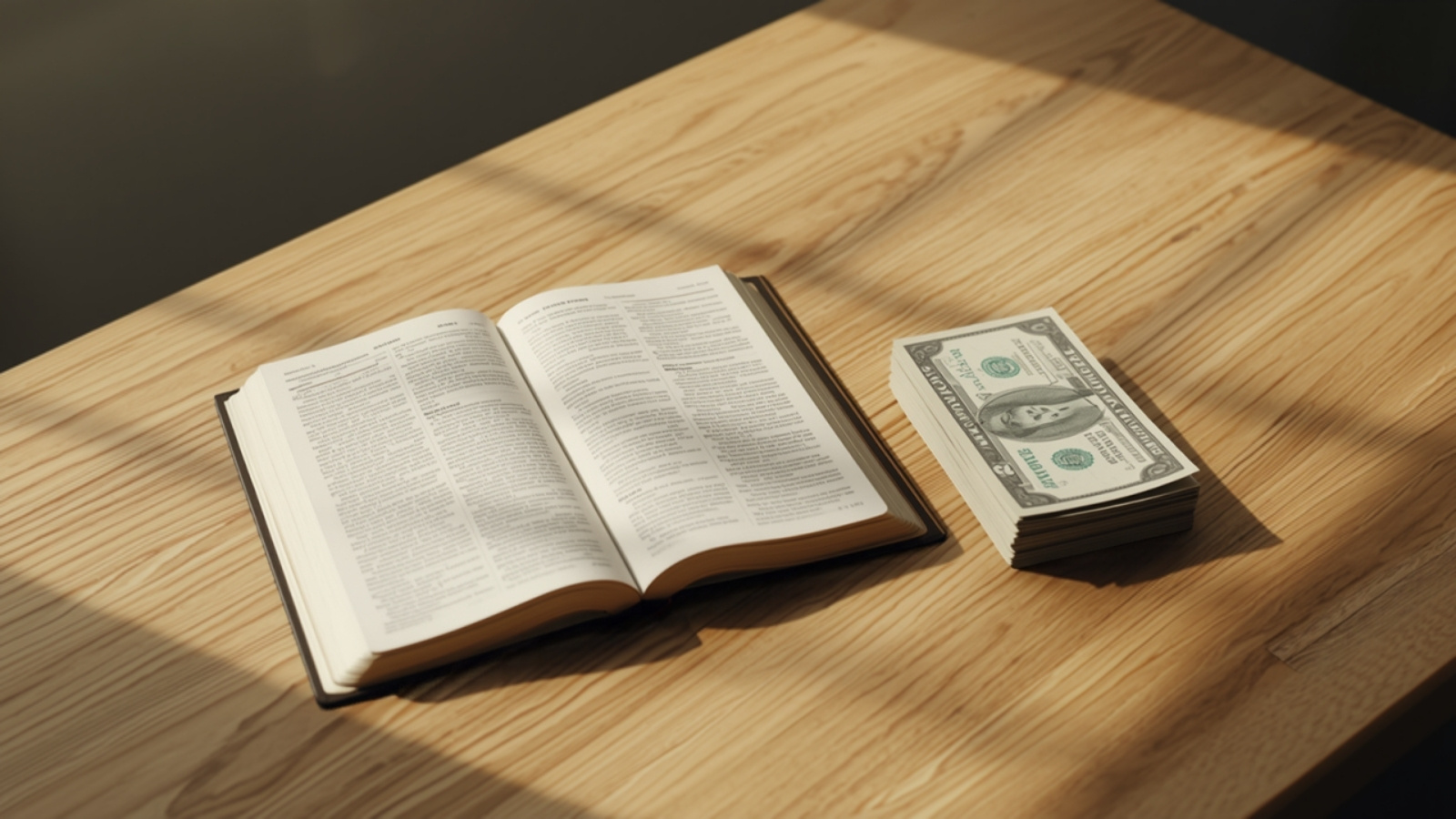
Somebody wealthy gets caught doing something rotten, and within a day you’ll hear it.
“See? Money is the root of all evil.”
It gets said with a smile and a slightly uptilted nose most of the time, as if the person saying it is somehow untainted by this evil thing called money. And it gets said most often by people who don’t have much. The successful guy did something wrong, so the money must have done it to him, and the whole idea of money gets polluted because of one man’s behavior.
I’ve heard it my entire life. In church, at family tables, in comment sections. And almost nobody who says it has ever looked up the verse they’re quoting.
First, Who Wrote This and Why
The verse is 1 Timothy 6:10. Forgive me, but I need to explain a little bit more of the biblical context before I dive into why this verse is so often misquoted.
The guy who wrote this is named Paul. He was an apostle of Jesus Christ, and he’s writing to a guy named Timothy, who was a younger coworker in ministry. It’s important to note that Timothy isn’t just some random person receiving general advice from this guy Paul. He’s actually someone that Paul has given a leadership role to. Paul instructed him to start and lead churches. One of those churches is the one in Ephesus, and at the very beginning of what Paul said to Timothy, he said to him, “Stay on at Ephesus to instruct certain men not to teach false doctrines.”
In other words, what you need to understand is that Paul wanted Timothy to help protect the church from any teaching that sounds religious but produces the wrong kind of life. Paul didn’t want him or anybody in Ephesus to get caught up in speculative arguments or myths or genealogies or any disputes about Old Testament law that doesn’t produce godliness.
By the time we get to chapter 6 of this letter that Paul wrote to Timothy, it starts to get a little bit interesting. Paul says that there are people who are teaching things that are contrary to what Jesus taught, and Paul describes them as being conceited, argumentative, and people who cause friction.
In 1 Timothy 6:5, Paul says that these people are looking towards godliness as a means of gain, and then he says right after that, “Godliness with contentment is great gain.” And that is the setup. He goes on to say that we brought nothing into the world, and we’re not going to take anything out of it. We’ve got food and clothing, and that should be a reason enough for us to be content. Then he says something interesting: “But those who desire to be rich fall into temptation, into a snare, into many senseless and harmful desires.”
The Four Words Everybody Drops
And then comes the verse that gets misquoted more than just about anything else.
And if you pay attention to the progression of what Paul wrote, he said that false teaching leads to using godliness for financial gain, which leads to a desire to become rich, which leads to temptation and destructive desires, which leads to a love of money, which leads to an abandonment of your faith, and which leads to personal suffering. That’s the progression.
Paul didn’t say money is bad. He said the love of money is the root of all kinds of evil.
Not money. The love of it.
Take the words “love of” out of a sentence and you’ve changed the subject entirely. One version indicts a human appetite. The other indicts a thing that has no ability to want, choose, or do anything at all.
There’s a second problem with the popular version, though it’s less clear cut. The King James renders it “the root of all evil,” while most modern translations say “a root of all kinds of evil.” The Greek has no article in front of the word for root, so translators have to decide whether to supply one, and honest people land in different places on that. That part is a real debate.
The dropped words aren’t a debate. Every translation I checked, including the King James, says love of money. The popular version isn’t a variant reading. It’s just wrong.
Money Can’t Be Evil, Because We Made It Up
Okay, enough of your Bible lesson today. The thing that settles it for me isn’t a theological argument at all. Let’s get philosophical for a minute.
Money is something human beings invented. It isn’t a substance we discovered lying around with properties attached to it. We agreed that a thing would represent value, and then we all kept agreeing, and that agreement is the mechanism we call money.
Go back far enough and you can watch it get built. In Mesopotamia, more than 5000 years ago, temple administrators needed a way to track rations and debts, so a silver shekel was fixed by decree as equal to a measure of barley. It wasn’t a coin. It was a unit of weight used for accounting. Coins stamped with the images of animals and rulers didn’t show up until Lydia, in what’s now Turkey, roughly 2600 years ago.
Units of account came thousands of years before the first coin. And the standard story you were taught in school, that people bartered until barter got clumsy and somebody invented money to fix it, is disputed by a good number of anthropologists who read that record differently. (And in case you’re interested, I am actually going to dive into this in next month’s articles. Stay tuned, because I’m going to take that apart and dismantle it one piece at a time, and you don’t want to miss it.)
For today, the point stands on the uncontroversial part. Money is a human agreement. It has no will, no intent, and no moral weight of its own.
A hammer builds a house or breaks a jaw. Nobody blames the hammer.
What the Misquote Is Actually Protecting
If the verse is that easy to check, why does the wrong version survive?
Because it does a job for two very different people.
For the person who never built anything, the misquote converts an outcome into a virtue. Not having money stops being a result of choices and circumstances and starts being evidence of clean hands. It’s a scripture-shaped reason to stop trying, and it comes with the comfort of moral high ground.
For the person who has plenty, it works differently. Quote it at the right dinner party and you sound humble, wary of your own wealth, appropriately conflicted. Then you go on doing exactly what you were doing. The verse becomes a costume.
Both uses share something. Neither person has to change anything.
The Love of Money Doesn’t Require Any Money
The love of money is fully available to people who don’t have any.
You can be consumed by money you’ve never held. You can organize your whole inner life around a number you’ve never hit, resent everyone who has, and check what other people paid for their house. That’s the exact condition Paul was describing, and having an empty bank account is no protection from it whatsoever.
I’d go further. Some of the people I’ve known who were most gripped by money were people who had very little of it. It ran their conversations, their comparisons, and their opinion of nearly everyone they met.
The verse isn’t asking how much money you have. It’s asking how much of your attention it owns.
What Scripture Actually Says About Wealth
The Bible isn’t squeamish about money the way church culture often is. The Bible talks about money, wealth, and possessions more than almost any other practical subject. Some studies count more than 2300 passages dealing with money and possessions.
Proverbs treats diligence as a virtue and treats wealth as a tool that can be used well or badly. Abraham was rich. Job was rich, lost it, and got more. Solomon’s wealth is described in detail without apology.
What scripture is specific about is what happens to a person who worships it. That’s a warning about the heart, and it’s aimed at everyone in the room, not just the ones with money.
I’m not making a case for prosperity teaching here. God is not a vending machine and your faith is not a deposit. I’m making a much smaller case, which is that the Bible’s actual position on money is more careful than the bumper sticker version most of us grew up with.
What This Lie Costs You
If money is dirty at the root, then wanting it is shameful, and shameful things get pursued badly.
You underprice, because charging what you’re worth feels greedy. You apologize in the middle of your own proposals. You get uncomfortable when a deal goes well, and you soften your numbers before anyone even pushes back on them.
The belief doesn’t keep you pure. It keeps you underpaid, and it leaves a low-grade resentment toward people who don’t carry the same hangup. I wrote about a related version of this in Money CAN Buy Happiness, and about what money can’t do for you in More Money Doesn’t Buy Freedom.
Now What
Two things this week.
- Notice when you do it. Think about the last time you heard that somebody was doing really well and something inside you resented it a bit or made you feel “less than” them. Maybe you said a version of this line out loud. Maybe you just thought it. Either way, that reaction isn’t about them.
- Find the thing you’ve been undercharging for. Name it, name the number you’d charge if you didn’t feel weird about it, and quote that number to the next person who asks.
Neither one takes an hour. Both will tell you something.
Words of Wisdom
“Give me neither poverty nor riches, but give me only my daily bread. Otherwise, I may have too much and disown you and say, ‘Who is the Lord?’ Or I may become poor and steal, and so dishonor the name of my God.” – Proverbs 30:8-9
Look at what Agur is asking for there. He names two dangers, not just one.
Too much money can make a man forget God. Too little can make him do things he swore he’d never do. Both conditions are spiritually dangerous, which is not how most of us were taught to think about being broke.
Poverty isn’t holiness.
Wealth isn’t wickedness.
The man who wrote that prayer understood both, 3000 years before anybody printed it on a coffee mug and got it backwards.
Before You Go…
What’s Real? goes out every Wednesday. One lie dismantled, one truth delivered, with the research behind it. If you’d rather have it land in your inbox than check back here, subscribe at therealjasonduncan.com.
And if you run a company or belong to an association that puts on events, and you’d want this kind of talk on the stage, I’m booking keynotes for 2027. Details are at therealjasonduncan.com/speaking.
– The Real Jason Duncan