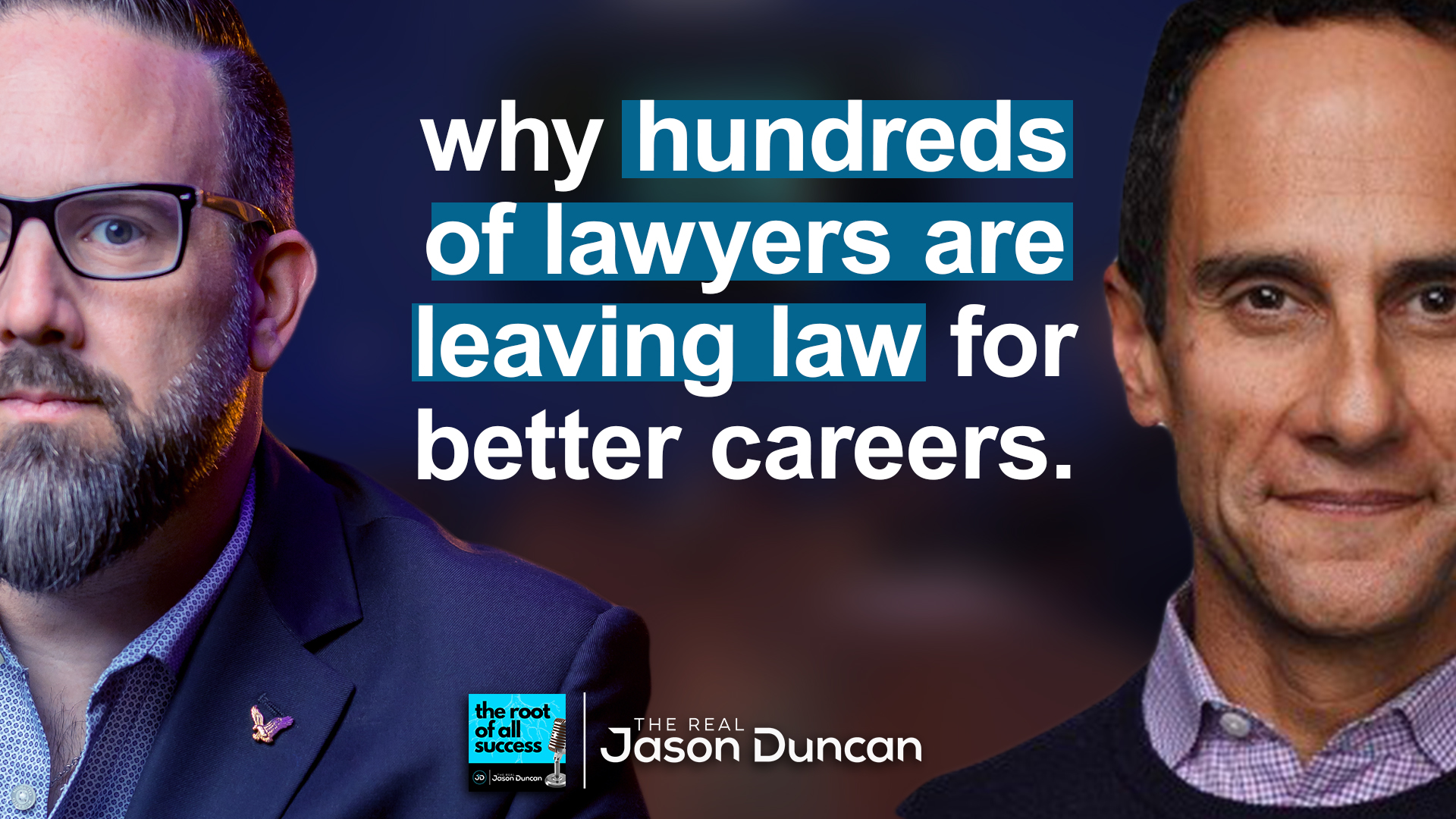
Why Hundreds Of Lawyers Are Leaving Law For Better Careers
Prefer audio only?
About this Episode
Most people stay miserable in careers they hate. Casey Berman walked away from law 20 years ago and built a half-million-dollar coaching business helping hundreds of unhappy attorneys do the same.
In this episode of The Root of All Success, Jason Duncan sits down with Casey Berman, former attorney, entrepreneur, speaker, and founder of Leave Law Behind, a nationally recognized coaching platform. Casey left legal practice in 2004 and spent years in consulting, operations, and running a family investment bank before realizing burnt out lawyers needed a roadmap out.
Casey breaks down why the legal profession is deeply tied to identity, how a single thank you email turned free coffee meetings into a six figure business, and the exact three-step system he uses to help attorneys transition into careers they actually love, without ads, funnels, or venture capital.
This conversation dives into:
Why lawyers can't admit they're unhappy: ROI on law school, parental approval, student debt
Casey's 2004 exit from San Francisco tech law
How free coffee meetings turned into a business idea
The email that changed everything: "I wouldn't have this job without you"
Landing 3 clients at $750 each and scaling to $500k without ads
The 3-step Leave Law Behind framework
Why "I can't do anything but law" is false
Real career pivots from law
The myth of lawyer salaries
Why lawyers struggle to change careers
Mental health challenges in legal practice
How lawyers have transferable skills
Why informational interviews beat job applications
If you're a burnt out attorney, a professional feeling trapped, or an entrepreneur learning how to build a coaching business organically, this episode will show you the exact steps to escape and rebuild.
🎧 Watch the full episode now 👉 Subscribe for more conversations on career transitions, entrepreneurship, and building freedom. Who is Casey Berman? Casey Berman is a former attorney, entrepreneur, speaker, and founder of Leave Law Behind, a coaching platform that helps unhappy lawyers transition into fulfilling non-legal careers. After graduating from UC Berkeley (Go Bears!) and UC Law San Francisco, Casey practiced technology law in San Francisco during the dot-com boom for about 5 years before leaving in 2004. After leaving law, Casey spent years in consulting, operations, and running a family investment bank and fashion company while figuring out his "unique genius." In 2007, his law school's career services office started sending unhappy students to meet him for coffee. By 2009, after receiving a life-changing thank you email from someone he'd helped, Casey formalized his coaching practice. He threw a dinner party at his dad's North Beach office in San Francisco, invited 25 lawyer friends, and landed 3 clients at $750 for three sessions. One of them, Gabe Rothman, became a rising star in San Francisco tech. Casey has since helped hundreds of attorneys leave law and has scaled Leave Law Behind to over $500,000 in annual revenue – entirely through organic SEO, blogging, free resources, and word of mouth (no paid ads). Leave Law Behind has been featured in The Wall Street Journal, The Washington Post, The Atlantic, The Guardian, and Above the Law. Casey splits his time between Maui and San Francisco with his wife and two kids. Casey Berman's Website: www.leavelawbehind.com Casey Berman's Featured In: The Wall Street Journal, The Washington Post, The Atlantic, The Guardian, Above the Law Casey Berman's Location: Maui, Hawaii & San Francisco, California Love the show? Subscribe, rate, review & share! https://therealjasonduncan.com/podcast Resources Mentioned: Dubb Video Platform: www.therealjasonduncan.com/dubb Follow Jason Duncan: Instagram & LinkedIn @therealjasonduncan
About the Guest
Casey Berman
Guest
Casey Berman is the founder of Leave Law Behind (www.leavelawbehind.com), a nationally recognized coaching and content platform that helps unhappy attorneys leave the legal field and transition into "non-law" careers they love, are good at and pays them well. Leave Law Behind has been featured in or covered by the Wall Street Journal, The Washington Post, The Atlantic, The Guardian, among other publications. A former attorney himself, Casey launched Leave Law Behind over a decade ago to help lawyers overcome fear, rediscover their transferable skills, and find non-lawyer roles that align with their strengths, values, and lifestyle goals. He’s helped hundreds of attorneys break free from burnout and self-doubt and take confident steps toward more fulfilling, sustainable careers. Casey is a speaker, writer, and entrepreneur who, with his wife and two children, splits time between Maui and San Francisco, his hometown and where he was raised. He brings a thoughtful, down-to-earth perspective to conversations about career change, entrepreneurship, mindset, emotional resilience, and building a life that works for you.
Never miss an episode.
Subscribe to The Real Jason Duncan Podcast on your favorite platform.
of really like what am I wired to do well? What do I do well? And if I enjoy
that, I can then be of service and help people and then you can get paid and grow and have confidence and
satisfaction and also helping people. So he walked away from a law career and
instead of starting over, he built a business helping hundreds of other unhappy lawyers do the exact same thing.
Today's guest turned his own escape plan into a half million dollar coaching
platform and he did it without a single ad. Welcome back to the root of all
success. I'm your host, the real Jason Duncan. This is episode number 349 and my guest is Casey Burman, an
entrepreneur, a speaker, and the founder of Leave Law Behind. Casey is a former
attorney who left legal practice over two decades ago, and he eventually built a nationally recognized coaching
platform that helps unhappy lawyers transition into careers they actually love. So, Leave Law Behind has been
featured in the Wall Street Journal, the Washington Post, The Atlantic, The Guardian, among others. And Casey has
helped hundreds of attorneys break free from burnout and self-doubt and find
non-legal careers that align with their strengths, their values, and and frankly their lives. He splits his time between
Maui and his hometown of San Francisco with his wife and two kids. Uh he today
he's coming from Maui. So Casey, welcome to the root of all success. Oh, thanks for having me. Uh really
really honored to be here and and excited about this conversation. So, thank you and appreciate your kind words. Yeah. Well, I'm I'm glad you're here.
This is going to be a great conversation because uh as we were talking pre-show, while you work with lawyers who are
burned out and don't think this is the right thing and they're they're dealing with doubts about things, I'm I work with entrep just general entrepreneurs
about the same thing. And of course, I have a couple lawyers. I think I told you in our in our mastermind, but you are specifically helping lawyers
leave law, which sounds u I I guess on the surface would sound pretty simple until you realize how
deeply the legal profession is tied with the person's identity. So, why do you believe it makes it so hard for an
attorney to admit that they want out? Yeah, it's a it's a great great question
and you know, I want to make this conversation as actionable as possible. So, this can help people who are
attorneys, want to leave the law. This can help people who in your audience who aren't attorneys but still want to leave
their job. But also, I I really hope there's a lot of nuggets here for people who are entrepreneurs starting businesses that I really want to get
into. So, I want to keep that in mind. But really it's what makes it so difficult is there's fears, there's
blockers, there's obstacles, there's doubts, all of that which everybody has, particularly with lawyers and also a lot
of professionals and ambitious people in type A. There's I was just got off the
phone with someone who is not very happy in her job, but a number of what we call the usual suspects have come up, which
is she's uh when will I get the return on investment? I put all this time into law school. I put all this time into
student loans. When will I I want to get my ROI before I leave the law? What will my parents think? Um how will I do a
non-law resume? How will I do all of this? And so there's a lot of fears and blockers that prevent lawyers from
leaving law. Some of them you'll see in other people who across kind of all audiences, but many of them are
particular to kind of these really high striving people like lawyers. And and what we do is really help them overcome
those blockers and fears intellectually and also also viscerally. But that's really the first step is getting those
fears and blockers out on paper so they can kind of see them and we work through them. Then you yourself you left law back
around I think 04 of my research if I'm remembering that correctly. So
yeah take us take us back to that moment about that decision and what was going
on in your life and your career that made you say man I'm done with this. I don't want to do this law thing anymore.
Yeah. Well you know I'm I'm 52. I'm an 80s kid. You know I went to Cal Berkeley. I'm a California kid. Went to
Berkeley and go Bears. And then I went to law school in San Francisco. Um UC
Law, San Francisco right now. And you know, I just didn't throughout those years in the '90s, I just didn't think critically about it, right? Like I just
I didn't like blood, so I'm not going to be a doctor. I'm not a math guy. I won't go engineering. It was all just, well, I
guess I'll go to law school. And my friends did it, too. My parents were cool with it. And my parents were great, very supportive, but they were like,
yeah, this sounds great, right? Our kid wants to be a lawyer. Beautiful. So, I just really didn't think critically
about it and nor did a lot of attorneys um really think about do I is this what I want to do? And then you get smacked
with the the real life of of being a lawyer and it doesn't look like LA law or CSI or all these other law shows out
there. It's a it's a lot different. And and what it really comes down to for lawyers and I think for a lot of people
who are unhappy in their careers, it's the work. They could go to a small firm, they can go in-house, they can change,
whatever, try a different law practice, but they don't like the work. And so when when it really hits them, oh my
god, this is the work I don't want to do. What we then do is help them understand their their skills are transferable and they can move into
another line with different work, different stakeholders, things like that. But that was really for me. I just didn't think critically about it.
Yeah. Well, it is a lot of work. I mean, uh, I think I think non- lawyers look at
what they see on television and think, okay, well, they're just showing up to court and they have some suave way of of
convincing these 12 strangers that their their client is innocent. Uh, that the
other person is guilty, but they don't I don't think it go I don't think it gets too deep into the the endless research
and reading the case file, you know, the precedent and all that kind of stuff. I I I you know, it's probably a terrible
uh terrible example of reality, but this the the the TV show Suits, which I which
I thought was I love that show, but I I don't know how much of that was real, but it did show at least some parts of
how hard the legal profession actually is. It's really, really difficult. And I
want to first I'll say so not so that lawyers don't get totally mad at me. If you enjoy law, if it aligns with you,
please, the world needs good attorneys. Please stay in law. Keep doing I say it all the time. I'm not here to bash the
industry at all. If you enjoy it, you love it, your clients need you, please stay in law. But if you're a lawyer or
really anybody who's just not aligned with it, they're just not aligned with the work, not not aligned with the
industry, there are look for something else. Ask for help. Look for look for something else. But the the work itself
is adversarial. It's obviously litigation is latigious. you're there's a lot of fighting sometimes they're
glorified paper pushers uh you know I mean there the you've got clients that don't really care about it hey I need
this yesterday you know you're working weekends you're missing vacations I could go on and on and on there is it is
a besides like frontline you know nurses our soldiers policemen EMT besides those
real frontline workers when it comes to a professional job lawyers are the ones that have almost as equal amount of
stress just due to the anxiety the the perfectionism that's needed. It it takes a real wear and tear on their
bodies and their minds. Yeah. So, after leaving law yourself, you went into consulting and operations.
You even ran a family investment bank and a fashion company. So, how did those experiences shape what eventually became
Leave Law behind? Yeah. So, I uh and I want to I don't want to bore everyone with my life
story, but I practiced for about 5 years. San Francisco technology 2000.com, you know, dogs in the office,
gummy bears in the kitchen, all of that. I had the job most lawyers wanted. But for me, it was still very reactive. Uh I
just wasn't really being able to create, be proactive. And so, I left. Everyone thought I was crazy. This was back in
2004. It was right before I was getting married. And so um what happened is my career services office as I was doing
consulting in kind of 05 06 07 understanding my unique genius kind of
just trying to make some money looking consulting doing things uh the career services office at my law school when
they had some kids first years or two or second years who didn't want to be a lawyer they're like I don't want to go
into a firm they didn't know what to do with them so they would send them downtown hey go get down the subway meet Casey downtown have a cup of coffee he's
he's an alum he left the So I would have a few coffees with these students, you know, I'm I'm just a graduate a few
years before them and and then it hit me. They were asking me about my story, my life. So back then I got a blogger
account. I started blogging. I just kind of if there's it's still online, my old blogs. I'm kind of embarrassed by them,
but I just started writing about my path. It was like a a private journal that I started just put online and
Google picked it up and just started people started finding me. Hey, you want to coach? I didn't even know what
coaching was in 09 10 11 12 like coach what are you talking about like like
49ers coach football coach what exe you know career coach but then um I just started started doing a lot of writing
for this website above the law I sort of formulated my my steps my point of view and uh it just it just went from there
it just kind of shows that when it when something say you're starting a business or or something when it really comes authentically kind of from who you are
just get out there don't be afraid if it doesn't look good or or don't wait for perfectionism. But um the world kind of
found me. So when you know you were meeting with these unhappy these students who were unhappy with it, when did you realize
that this wasn't just doing somebody a favor, this could actually be a business? Yeah, I that's a great question. I
met with someone in about 07 2007
and then in 2009 they sent me an email out of the blue. I
forgot their who they were. They sent me an email. I think it went to my spam folder and they said, "Case, I don't know if you remember me." And they got a
job at at a tech company in San Francisco. We're making a ton of money and we're over the moon about it. And
said, I don't know if you remember our conversation coffee in May 2007, but I I
wouldn't have this job without you. I'll never forget those words. And I'm not I'm not trying to brag. It just I'm
almost getting tears in my eyes remember thinking that like what I I did like I
did I I did what? So that was the moment where I said huh
wow I had I had a real impact a positive impact on someone and it was it was very moving for me and it also showed Casey
you you got to do a little bit more here. Get start acting on it. So that's where it really started. So that email said hey people would pay
me for this type of advice. Is that when that started? Yeah. I was like, "God, I did all that for free." But yeah, that's when it
started. And I literally threw a party. A friend of mine said, "Go." And I threw a dinner in 2009. And uh and I about 25
people. I just kind of sent it out to a bunch of lawyer friends. We got 25 or so people at my dad's office up in North
Beach in San Francisco. And um and near Fisherman's Warf. We had an office
there. And I got three clients out of it. Out of those 25, three people signed up. I charged 750 bucks for three
meetings and one of them Gabe Rothman is one of my I go to I helped him leave the
law and move into technology and I was a rising star in the in the San Francisco tech space. Uh he's already a star he's
not rising but um so yeah that that's where it went from there. I just kind of started moving forward and I didn't know what I was doing but I just started
getting up it and and so that was in what 2010? 2009. Yeah, fall 2009.
All right. So 2009. So then you took that idea, leave law behind, you started
the business and you scaled that to half a million in revenue without any heavy advertising most mostly through as you
said blogging, free resources, word of mouth, but so in a world that's obsessed with paid ads and funnels,
h how did you how were you able to work that so organically? Well, so I tried Google Ads in 2012, 2013, and
I had hired someone on Upwork, really great guy out of New York. He did it well, created and it just didn't give me
the results that I was getting from from SEO and from and I didn't even do formal
SEO in 11, 12, 13. I was just writing my blog. I was just getting it all out there. We did formal SEO in 2019. We
actually kind of formalized it and and got a lot of traffic that way which is changing now with the AI synopsis which
I can get into get into later. But um we just I was just writing content
regularly back in 2010 11 12 13 14 15 um and then you have you have word of mouth
and then I got picked up by people wanting to talk to me from the the newspaper articles. So, um, obviously
that was all pretty much pre-social, but, um, you know, it was really it was really about that and there's then you
just realize there's a real need. I mean, these people are miserable. Yeah. And so, what does the coaching model actually look like? If a burned
out attorney reaches out, they walk through the door. What's the first thing you help them see about themselves?
Yeah. And I'll give it away. Like, I give everything away. So, here it is. I'll take you through the steps. Take notes if if you want if you're an
unhappy attorney or if you're someone who's just uh unhappy in their job. But there's three main steps to leaving the
law. One, understand your fears and blockers. Get them out on paper. We want to overcome them fully. Or if that's too
much, let's just mitigate them. Let's just reduce them so you can at least move forward. Cuz some people are absolutely paralyzed. I will not leave
the law or I will not leave my job until X happens. Well, X may not happen. You
may not find, we may not know if you're going to make $267,000. We may not know if your dad's going to
approve it, but let's still move forward. So the first one is the fears, blockers, obstacles, and just and people
say, "Well, I can't overcome them." Great. So we'll just reduce them. Just make them a little small. The second one is your unique genius, your skills and
strengths. And this is the part I love it is just what are you good at? I mean, I really am about, you know, success.
That's what your podcast is about is really for me is when you're doing something that you're really good at and can be of service. But I'm a sports fan,
so if you think of a scouting report for athletes out there, but it's we have three questions. Are you ready? Um, ask
people to compliment you. What are you good at? What advice do they come to you for besides legal advice? And what have you done or what do you do for free? You
collect all of the traits that people give you. We help you organize them or organize them yourself. There are jobs
looking for those traits. That's your transferable skills. But really, it's about your skills leading to the job,
not the other way around, right? Like, oh, I just want to get a job for security. And then Jason, 10 more seconds. I know I'm talking long here.
The third one is um then the third step is getting out there. Informational interviews. Don't apply to monster.com
please and hope the ding and get the resume. It doesn't work that way. Informational interviews. And really
what happens is we help people find jobs that really haven't even been posted yet. So overcome your fears, understand
what you're good at, and get out there in a real strategic organic way. Those are the three. That's how the coaching
works. All right, we're going to get back to Casey in just a moment, but first I want to ask you, Mr. Mr. Mrs. Listener,
please follow me on Instagram or LinkedIn. You can find me at the realjason Duncan. And then on those
platforms, I share daily insights. I share behind the scenes content, practical coaching, and entre, you know,
that'll help you as an entrepreneur build your business that sets you free because I believe that entrepreneurs
should be a slave to their business. So, come find me, say hello, go find me on LinkedIn or Instagram at the realjalason
Duncan and uh let me know you heard this show and uh that'll be cool. send me a DM. Now, for a word from today's
sponsor, Dub. That's spelled D U BB. So, if growing your business with
personalized video outreach has ever been on your radar, then you need to know about Dub. It they Dub is the
ultimate video sales platform that I've personally been using since 2018. And
I'm not exaggerating when I say I use it nearly every single day. Dub makes it so easy to record and send videos that
stand out in a crowded inbox. Um, it it they you could set up clickable calls to
action with the people who watch your videos. They can instantly book a call, they can reply, they can take the next step, whatever you want them to do. You
can actually see if they clicked it, if they watched it, how long they watched it. They click the CTAs and you get real-time analytics that tell you
exactly how your videos are performing, helping you tailor your follow-ups. And let's be real, it helps you close deals
faster. So whether you want to boost email engagement or you want to ramp up your social media presence or you want
to speed up your salesunnel, Dub has the tools to make that happen without
complicated software without all this lengthy setup crap. If you want to see how Dub can work for you, all you got to
do is go over to the realjason.com/dub. Again, that's spelled dubb and learn
more. And you can get started today with a discount and you get 50% off your first two months. That's the
realjason.comdub. Thanks to Ruben and Darius and all the guys out there for sponsoring the show.
Now, let's get back to the show. So, Casey, you talk a lot about fear being
the biggest barrier for lawyers. So, I'm interested to know what what specific
fears show up the most and how do you help somebody move through those fears instead of just staying stuck in them?
Yeah. So one of the big fears lawyers have and this is an important question and I think many other many people have
whether entre entrepreneurs or or looking for another role is that I can't do anything else but law. I can't do
anything else but X. This is what I'm here to do. This is what my skills are fit for. And we show them of all the
people that your skills and strengths don't really change. Sure, you get they're framed in a different way and
you're going to learn new skills and gain new muscles, if you will, in a new job. But when you think about it, what a
lawyer does, analyze, be the adult in the room, put out fires, be air traffic
controller, do great research in detail, also tell a story, persuade people. I
could go on and on. There's hundreds of skills that lawyers have. Those are needed in other roles. Those are needed
in strategy consultant roles. Those are needed in operation roles. So, I'll give you an example of an attorney we just
left who was a tax attorney for many years, big brain, super sharp, super
sharp, super smart analysis, the type of guy who thinks four steps ahead of everybody, love politics, love policy.
Well, he went from being a a tax attorney, and now he's doing analysis
and thought leadership for a think tank that he's completely aligned with from a political standpoint. He works at a
think tank. He was a tax attorney. We have millions of those stories. And so I really want to debunk that myth, that
fear that while I have skills A, B, and C, I can only do job X. It's not the case.
So lawyers, as you were kind of indicating, they're they're trained to think analytically like the tax guy.
They were trained to argue. They're trained to find risk. Um, how did those skills actually become advantages in a
non-law career? And and and then I guess on the other side, how does sometimes those things get in the way?
Well, I'll start with the second question. So, the disadvantage is just that they they're been trained and this
is great for their clients. Risk mitigation, hey, we got this coming down the pike. So, that is excuse me, that is
a great skill for lawyers to have. You don't want them to be willy-nilly. Risk mitigation is something lawyers need to
have. But when it comes, this same skill that is so great as a lawyer, when it comes to their own career development,
it completely gets in the way. um they become totally riskaverse. They won't
change. They won't move forward. They stay stuck. They stay miserable. Now, a lot of these skills then when you go
into another job, you don't need to be where the the buck stops. So, there's
another lawyer that I know who had a will and estate uh trust practice. Um he was a comedian on the side. So, here
he's doing trust and estate work, managing risk, all of that for for his
his uh clients. But he would do comedy on the side. Obviously an interpersonal guy, fun guy. Well, he moved into
planned giving into fundraising. He worked for two universities and now he's worked at a at a working at a he got
poached. He got recruited for a major hospital in Northern California. Well, he sits down. He literally has lunch and
coffee five or six times a day meeting with donors or alums or whoever the case may be. And he's really able to give
that advice about how they can do planning if they want to make a donation. But he doesn't have to do the legal work. So he's he's in a pig and
you know what, right? He doesn't have to do it. He loves it, but he also gets to tell jokes, be that personable person.
So he gets to have his cake and eat it, too. But a lot of the things to look out for, he brings it onto their radar and
they feel more educated, but he doesn't have to be the deal killer. He doesn't have to be the risk guy. He brings it up
on the radar. But you let have your attorneys keep this in mind. They feel great because they got this heads up. He
feels great because he looks smart and he's helping them, but he doesn't have to do the legal work. It's a win-win.
That's great. So, you you emphasize a lot the transferable skills as a cornerstone of the work that you do. So,
um if you had to think about all the skills, what's the skill most lawyers are undervaluing about themselves?
Yeah, it's a great question. So, transferable skills, let me let me
define it for everyone so we know what it is. And again for for non- lawyers as well this is applicable but the idea is
not necessarily that your skills change. Your skills are still there. The muscles are still there right? Same muscles same
skills. It's more about just translating them reframing them. So it's in the translation for a job. So if you think
of risk mitigation, you think of of all the things that a lawyer does, um
they're thinking about how I apply it in a in a lawyer job. Well, what I'm saying
is that you can apply it elsewhere. You can reframe it. So, strategy is huge is
is a big job nowadays. Operations is a big job. When you really think about it, a lawyer is a project manager. They're
getting trials and cases and deals across the finish line. That's they got to herd cats and bring young associates
and bring all these people together. That is what project management is. They don't think of it that way. But so so
the idea really is that understanding that it's kind of the same skills just
reframing it in a different way being very authentic, honest, truthful about it. But I think really the what I love
about lawyers is you've got a ton of skills. The big thing nowadays when you think about where we are with AI, where
we are with with where technolog is going, just how fast things are are changing is what I love that the skill
that lawyers have is this mix of strategy, just big highlevel thinking, keeping keeping the eye on the north
star. What is our vision? Why are we even here in the first place? Along with this empathy, and I know it may seem
strange, a lawyer with empathy, like they're out there bulldogs, they're being ruthless and just kind of killing
the other side. There are many who do that but there's a human element to being a lawyer and many lawyers have it.
They they can read the room. They can get a pulse on people. It's that EQ element. So that highle vision also with
that EQ element in a world of AI in a world of humanness is sort of in doubt.
That's a phenomenal new skill that I think is really going to rise to the forefront for for attorneys looking to
transition out. You know, a lot of a lot of people would look at an attorney and think, man, they've made it. They're they're
successful. They're doing great. They make a lot of money. So, what do you say to somebody on the outside who can't
understand why would a lawyer want to leave in the first place? First thing is they don't make that much money. If you Google median lawyer
average salary, it's uh some are in the 80s and 90s and many are in around 150
140 which was a lot of money when I was growing up but nowadays particularly in bigger cities that doesn't go that far.
So, that's one of the big myths. lawyers do not make that much money. Second of
all, with student debt, even if they do make good money, they have huge debt payments. So, yeah, revenue, but look at
the expenses, right? So, you've you've got that. Um I I mean, I spoke with an attorney who's making $700,000.
Uh but I mean, he works 247. I'll never forget there was a woman who we helped leave
litigation in Philadelphia uh to become a trust officer in in Delaware at this great bank. She absolutely loves it. I
did the math with her. She was thinking, you know, she bills over $100. She's making six figures. We did the math. She
was making about $62 an hour pre-tax. Then we did post tax and it was low 40s.
And hey, no offense to someone who's making $40 an hour. But when you think about this, the debt she had, the
expectations in life she had, she had no idea what she was making hourly, what she was bringing home post tax. She
said, "Forget it. I'm out of here." So, um, money, they don't make that much money. And and then then the other part
is just the suicide rate, the depression rate, the alcoholism rate, the drug abuse
rate. It is, as I was mentioning, just being on the front line. Lawyers are on the front line. It's they have to be
perfect. The anxiety, a judge will throw your whole memo out because of a typo. I
mean, there are those crazy stories, many of them are real. And so there is just so much pressure in the job for
attorneys who like it and also those those who don't necessarily align with it. So um there people are are they're
taking a toll on their body. So they don't make that much money and they're hurting.
What's something you used to believe that you don't believe anymore?
Uh, I used to believe that
everything that happened was a coincidence. Uh, you know, I used to believe, and not to get I don't want to
get too woo woo or anything like that. Um, but I I used to believe that if
something happened, it was just a coincidence. And now I think in life, I've had kids, I'm older, you know, I I
do I find more meaning in things. Uh, I can you can find meaning in anything,
but I I think uh it's it's finding more meaning in the day-to-day and um and
whether it's meaning that that other sources bring to me or or meaning I create when I see something um instead
of thinking as just a coincidence, I I view everything as kind of neutral and and really finding the meaning in things
that can benefit me or um or just kind of explain things. So that that's something new for me.
Interesting. Um, if you look back at how you've succeeded in this coaching business and perhaps even as you
succeeded in the in the law business before that, what has been the one key that has unlocked success for you more
than anything else? And I was a pretty good attorney. uh it didn't align with me, but I was a pretty
good attorney and I saw my path as being kind of general counsel in Silicon Valley where I could go. But I really
what the reason I left and and to answer your question was what what really helps unlock is this idea of sort of
self-awareness. And I don't mean it in again in a woowoo way. I mean it kind of going to the unique genius element of of
really like what am I wired to do well? What do I do well? And if I enjoy that,
I can then be of service and help people. and then you can get paid and grow and have confidence and
satisfaction and also helping people. So for me uh I wasn't being a lawyer wasn't
really connecting with the things I did well. I had to fight. I had to dig into details. I again I was the no no you
can't do that guy. I wanted to be the well let's do this guy. I wanted to be more creative. I wanted to go talk to
people. I wanted to be on podcasts like this. Right? And so, um, for me, success is really that self-awareness about what
you're what you're really good at. Kind of getting real myopic about that. So, is that has that been what's
unlocked your success? But what how do you define it? Like, what does that mean to you personally? What does that word mean?
Yeah. So, I So, for me, I define success as as um alignment as really that that
being in the zone. Um, so like it matches who I am. It matches who it
matches what I do. So it and and what is the result? I'm energized. I love what I'm doing. I mean, I'm on five and a
half, six hours sleep. I wish I slept more, but I just, you know, yeah, I had my bad days and I got an email this
morning which made my gave me butterflies in the morning and and I was like, oh no, like my day is starting off
wrong, but like I was looking forward to it and I'm like, you know what? I'm going to handle this. I'm going to be able to get this. And so for me, it's
that real it's that real alignment. It's not the titles, not necessarily revenue. It's that alignment, congruence. I I
just remember, you know, Tom Brady, he's a California kid. He grew up rooting for my NerS, so I have an affinity for him.
But he threw he threaded the needle with this football. And he just he just they they said, "What were you thinking when you threw that touchdown pass?" I saw
him in an interview and he goes, "I wasn't thinking. I was just in the zone. I wasn't thinking." And so we think too
much in a way, right? It's just that alignment when you feel it, you you know it. And so for me that that's kind of
how I define success. So by that definition of alignment, do you consider yourself to be successful?
I I do I do and I don't know if it's necessarily from other metrics, awards or titles or or whatever the case may
be, but um I saw a quote I don't know if you remember Snapple that that drink. I
used to drink it all the time before I realized how much sugar was in there, but great drink. But they had a little saying under the cap and it said um
uh your life expands or contracts in relation to the amount of courage you have. And I think you know I'm I'm
successful because I've had I've had courage. I've been scared. you know what, but I've I've had some courage and
I' I've just stepped into it and I've I've made a lot of mistakes, but I've taken some some risks and um you know, I
just got back from spring training with with my daughter and and took a few days off, went to go see our Giants and San
Francisco Giants play and you know, if I was if I hadn't had the courage to make changes, that sort of freedom and
lifestyle, I I wouldn't have. So, I'm I'm really reaping the benefits of kind of courageous decisions I made years
ago. So, I I consider that a success. Yeah. So if you think about now that you've kind of you you in your career
move from law into entrepreneurship, what is your best piece of advice for entrepreneurs?
I would say don't follow. So let me say the do
first. Do something that aligns with you. Yeah,
you want to find a pain and you want to need market fit and to help other people and so on that of course, but do
something that is you that that builds on your unique genius on your skills and strengths that comes from you. Don't
follow someone else's model. I mean, you spoke kindly about how we built our traffic organically, but I cannot tell
you how many times, you know, I won't even mention their names, but there were big gurus out there and I'm like, well,
he built his website that way. I'm going to build it that way. He does this. I'm going to do that. She did it this way. found to do it that way. And I was I was
going down rabbit holes there. And I just realized, look, I'm going to build my business. I'm going to take the good things, don't get me wrong, but I don't
want to really follow someone else's model without infusing my own to it. So, it's it's find that market fit. Do all
that business model stuff, but at the same time, do you don't build a business that requires you to kind of be someone
else, I would say. All right. I I also say, Jay, I was say like your unique genius is is an unfair advantage.
Let me put it that way. Like when you really look at sorry to interrupt James, but when you I just want to add when you really look at your skills and strengths
of what you're really good at, that is that's a real differentiator. It doesn't mean other people aren't like it, but it
it's a it's it's a real competitive advantage. So, as we as we finish up our
conversation, I want to go into some rapid fire questions. You ready for those? As ready as I can be. You're scaring me.
First one. Best thing about living part-time in Maui?
Besides the weather, everyone is just so nice here. Um, everyone's just nice and
open. There is a real aloha spirit. It it really exists.
So, uh, one the second question, one book that you recommend to every lawyer
who is thinking about leaving law. So, some people may laugh but at me and
it wasn't the best well-written book, but I got to say a million years ago I read Rich Dad Poor Dad and the
distinction between being an employee after tax dollars, right? I that just
blew my mind. And my father had his own firm and he was entrepreneurial and worked on his own. And I was a great
employee. I was a great employee climbing the corporate ladder. I was a people pleaser. I could do it all. I'd
be great at a company. But I just had this inkling of entrepreneurism and getting out there that I just I couldn't
I stifled it. Don't get me wrong. But just seeing how how that book kind of laid out, I would I just said I I can't
I can't be an employee really. I I have to do this. So I would I would definitely it gives a viewpoint that
many lawyers just don't have. I agree. Great book. Everybody should read it. Um all right, last one. Yeah.
Yeah. If you could go back and talk to yourself the day that you passed the bar, what are you going to say? What
would you say to yourself? So, great question because I failed the bar the first time
in November of uh 20 November of 99, I
think. Failed it. Got my results, was horrible, devastated. My life is end. Took it again in February 2020 and and
uh 2020, February 2000 and I passed. So that day in February to when I got my
results or a few months later um I would say um what I would say to myself back then
in the year 2000 as I would say um good stuff way to persevere through this way
to have the grit and that persistence and just to not back down. Um keep keep
this is a muscle. This is these are skills you're gonna need. Uh, and if anything, hey Casey, you may not have
passed the bar to be a lawyer, but you may have passed the bar just to learn how to accomplish something and and to
have that grit. I I I would have said something like that now. Well, Casey, thank you for uh for
spending some time with me on the route of all success today. Uh people can reach out to you by going to
leavebehind.com or they can follow you on LinkedIn at kcbermansf.
Any other ways that or things that you want to tell people about maybe they maybe a resource or how to get in touch
with you in a better way? Uh yeah, email me case a sys at leawbehind.com. Send me an email
anytime. You can also schedule a call with me uh directly on our website. Oneclick button, go to my calendar. Uh
but no, just I want to I want to extend these ideas. I I hope this is helpful. I always want to make any interaction I
have actionable and helpful or and enjoyable to people. So, um, looking forward to to hearing from folks.
Well, congratulations on your success and building a good, uh, career around helping people build good careers. So,
this is, uh, I I applaud you for what you're doing, help people getting unstuck and moving from something they
have, uh, you know, they've put a lot in. There's a lot of sunk cost there and, uh, and helping them see the light
that you don't have to just commit to that sunk cost forever. So, congrats on all your success, Jason. Thank you and and thank you for
having me. I'm honored, flattered to to be on the show. What you're doing is great and I just I just really
thoroughly enjoyed the the conversation. I hope it was helpful. But but thank you for having me. Well, there you have it. Another
successful entrepreneur showing us this unconventional road to entrepreneurship.
I mean, there's not many people I've had on the show that were once lawyers and now are helping other people also not be
lawyers anymore. That that I don't think I've ever interviewed anybody like that. So, if you are an attorney, this is
somebody you probably want to talk to. Unless, as he said, listen, if you're totally aligned, as he said, his definition of success, if you're totally
aligned with what you were doing, man, carry on. It's good. You're We need good lawyers cuz goodness knows we got enough
bad ones out there. But we need some good ones. We need some good lawyers. If you're that person, stay in it. And if you're a bad lawyer, you need to get
out. Go do something else. You're making everybody look bad. But, uh, thank you for listening to the show. It's an honor that you take time every week to listen,
uh, to watch. You know, we're on Spotify, we're on Apple Podcast, we're on YouTube, you watch us any of those
places. And we're just glad that you're here. I'm honored that you take time to listen to the show. If you got any feedback for me, please leave it. And uh
just glad you're here. So, make sure you tune in again next time when I talk with yet another very successful person about his or her journey to success. Until
then, as always, I am your host, the real Jason Duncan, and Jesus is King.
See you next time. Attention business owners. Attention
business owners. Feeling burned out from running your business? Uncertain if you're nearing
burnout? Take our free 10 question business burnout test at business
burnoutest.com to discover where you stand. With just 10 quick questions, you'll learn how to
immediately begin making changes to regain freedom and success. Cut your daily operations time in half. Improve
your quality of life and prepare your business for your future exit without losing revenue or profit. Visit business
burnout test.com now and take the test.
Thank you for listening to another edition of the root of all success with the real Jason Duncan. If you've enjoyed
this week's episode, visit the root of all success.com to access the show notes
and other helpful resources. Follow Jason on social media at the real Jason
Duncan. See you again next time here on the root of all success. ass.