
"The reason you want out is the same reason no one would want in."
That's what my business coach said to me back in 2018. I was sitting across from him with a million dollars in profit, an Inc. 5000 spot, awards on the wall, and a number in my head about what my business was worth.
He was telling me the number was wrong.
Most successful business owners are wrong about what their business is worth. They don't find out until the day they try to sell. By then, the discount is already baked in.
This is the lie no one warned you about. And the truth almost no one teaches.
It's not cool. It's not scroll-stopping the way a guy with a Lambo and a pretty girl in the passenger seat is.
Nevertheless, it is still a lie we need to face and unpack.
The Lie You've Been Living With
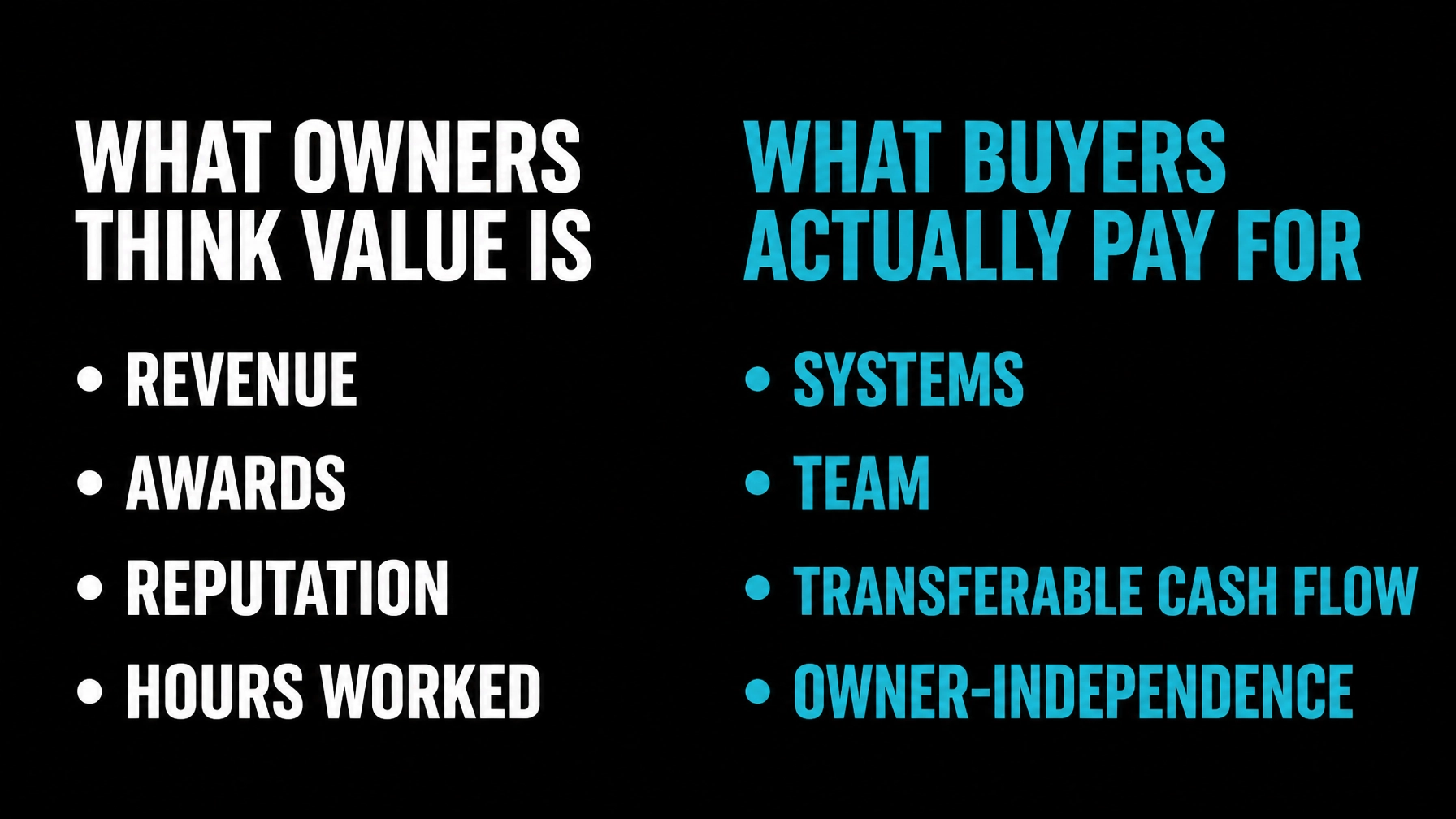
Revenue is going up. EBITDA looks decent in a good year. There's a plaque on the wall – Entrepreneur 360, Inc. 5000, maybe a local business journal award. The script you've been handed says all of this means something. It means you've made it. It means the business has value.
It doesn't.
Buyers don't buy your top line, your story, or the plaque on the wall. They buy what happens on the Monday morning after you stop showing up.
That's the cage. The gold is the revenue and the recognition. The bars are everything underneath. The parts that only work because you're in the chair every day.
I built one of those. A multimillion-dollar company that looked like success and operated like a prison. The day I tried to sell it, I found out it wasn't an asset. It was a job with my name on the door.
What Buyers Actually Buy
Here's the test. Pick a Monday. Any Monday. You're not in the office. You're not on email. You're not answering your phone.
What happens to the business that day? That week? That quarter?
If the answer is "everything falls apart," you don't have a business. You have a job that comes with a tax burden and a logo. (Ask me how I know.)
What buyers want is reliable cash flow that doesn't depend on you. They want documented systems. They want a team that can run operations without the owner in the room. They want customer relationships that live in a CRM and not in your phone.
Industry data from sources like the BizBuySell Insight Report and the Pepperdine Private Capital Markets Report consistently shows the same pattern. Businesses with operational independence trade at higher multiples than businesses where the owner is the operation. Owner-dependent companies sell at meaningful discounts, when they sell at all. Many never close.
Revenue is a vanity metric to a buyer. So is your reputation, if it doesn't transfer with the sale. So is your relationship with your top customer, if you're the only one who has it.
Face it: your business isn't valuable because it makes money this year. Your business is valuable to the degree that it will make money next year without you.
Edward, and the Closing Table You Don't Want to Sit At
Edward is the archetype I write about in Exit Without Exiting. Built a company over a decade. Sixty-hour weeks were normal. Eighty-hour weeks happened often enough that he stopped counting. He told himself the grind was a season. He told himself the next milestone would buy him out of it.
Eventually he decided to sell.
Buyers walked through the door, looked at his books, and walked back out. The ones who returned came back with a three-year earnout, which is corporate language for "we'll buy your business if you agree to stay and run it for us." He was trying to escape the prison. The offer was a longer sentence.
That's the Three Tiers of Entrepreneurial Evolution in action. Edward is a Tier 1 Owner-Operator. The business runs through him: every decision, every relationship, every escalation. To the market, an Owner-Operator business is functionally unsellable. It can change hands, but only at a steep discount, and usually only if the owner agrees to stay and keep the wheels turning.
The Owner-Manager (Tier 2) thinks he's escaped. He's built a more comfortable version of the same cage. The decisions still run through him, they just take a slightly more scenic route.
The Owner-Investor (Tier 3) owns something that runs without him. That's the only version of a business that has real market value. That's the version a buyer will pay full price for. That's the version that can be passed down, sold, or held forever as an income-producing asset.
If you're not sure which tier you're in, the chair test answers the question for you.
Why Most Owners Can't See This Until It's Too Late
There's a name for what keeps this lie alive. It's called Hero Syndrome. Being needed feels like being valuable. They aren't the same thing, but the brain treats them like they are.
Every decision that lands on your desk is a deposit in the cage. Every problem only you can solve is another bar. Every relationship that exists because of you and not because of the business is a chain.
Here's the cruelest part. This feels good. It feels productive. It feels like leadership.
It isn't. It's a slow-motion trap that compounds for years.
The longer the business runs on you, the more comfortable the cage gets. You stop testing the door. You stop wondering what would happen if you stepped away for a week, then a month, then a quarter. You tell yourself you'll fix it later, when there's more time, when the team is more ready, when the market is calmer.
Later never comes.
The market doesn't care about your awards. It doesn't care how hard you worked. It doesn't care how much your customers love you personally. The market values what runs without you. Period.
How to Find Out What Your Business Is Actually Worth
Stop guessing. Start testing.
The Architect has three jobs: set the vision, communicate the vision, and build the business as an asset. That's it. Everything else is a deviation, and every deviation makes your business less sellable next year than it is this year.
This is what The XOS Method™ exists to fix. It's a seven-stage path that takes an Owner-Operator and walks them up to Owner-Investor, one structural change at a time.
- Basic Delegation – Reclaim ten to twenty hours a week
- Building Your Support Squad – Operational foundation
- Developing Your A-Team – Empowered leadership
- Mastering Systems and Automation – Self-sustaining operations
- Creating a Passive Profits Machine – Revenue without daily involvement
- Exit Without Exiting™ – The business runs without you and you still own it
- The Ultimate Sale – Selling at peak value, only if you decide to
Notice what the framework doesn't do. It doesn't tell you to sell. Selling is optional. The point is to build something you could sell at full value, whether you ever decide to or not.
That's the truth most owners never hear. Your business doesn't become valuable when you sell it. Your business becomes valuable when it stops needing you. The sale is just the receipt.
Words of Wisdom
"Know well the condition of your flocks, and give attention to your herds, for riches do not last forever." – Proverb 27:23-24
Solomon was writing to herdsmen, but the principle hasn't aged a day. Your revenue is not the condition of your flock. The condition is whether the thing you've built can stand on its own, whether it would still be there if you weren't. Riches don't last forever, and neither does the energy of the one person holding it all together. Give your attention to what actually endures, not to the number that looks impressive this year.
The Conversation Happening in Denver Tomorrow
If you want to hear this conversation in person, with M&A attorneys and a managing partner from a private equity firm in the room, the timing is good.
I'm keynoting an event in Denver tomorrow.
In the Driver's Seat: Driving Value in Your Business
- Date: Thursday, June 4, 2026
- Time: 2:00 p.m. to 6:00 p.m. MT
- Location: Fennemore Law, 3615 Delgany Street, Suite 1100, Denver, CO 80216
- Host: Nicholas Thompson, Director and Co-Chair of the Mergers & Acquisitions Practice Group at Fennemore Law
- Guest Presenter: Scott Mitchell, Principal and Managing Partner at SDR Ventures
- Keynote: Yours truly
- Cost: Free
Drop in any time within the event window. Welcome, presentations, discussions, and networking run from 2:00 to 5:00 p.m. On-site happy hour from 5:00 to 6:00 p.m. Walk in, sit down, and stay as long as it's useful.
This is the conversation most owners don't have until they're already at the closing table trying to sell something worth less than they thought. The point of being in Denver is to have the conversation before then, not after.
If You Can't Make Denver
Most readers can't fly to Denver tomorrow. That's expected. The bigger question is what you're going to do with this once the inbox closes.
Pick a Monday in the next thirty days. Don't go in. Don't check email. Don't take calls. Let the business operate without you for one full day, then look at what broke. That's a free audit on the cage you're sitting in.
If you're an owner doing $3M+ in revenue or $300K+ in EBITDA, and what you just read sounded uncomfortably accurate, the next conversation might be with us. The Exiter Club™ is built for owners who've already won the revenue game and are starting to suspect they lost something else in the process.
Apply when you're ready.
The Gold Is the Lie
The cage is comfortable. That's how it works. Revenue, awards, reputation, the team that needs you – none of it is bad. But none of it is the same thing as a valuable business.
The gold isn't the value. The gold is the lie.
The valuable part of your business is everything that would still be there on a Monday morning when you're not.
Find out what runs without you. Build more of it. The rest is just a salary you're paying yourself with extra steps.

– The Real Jason Duncan