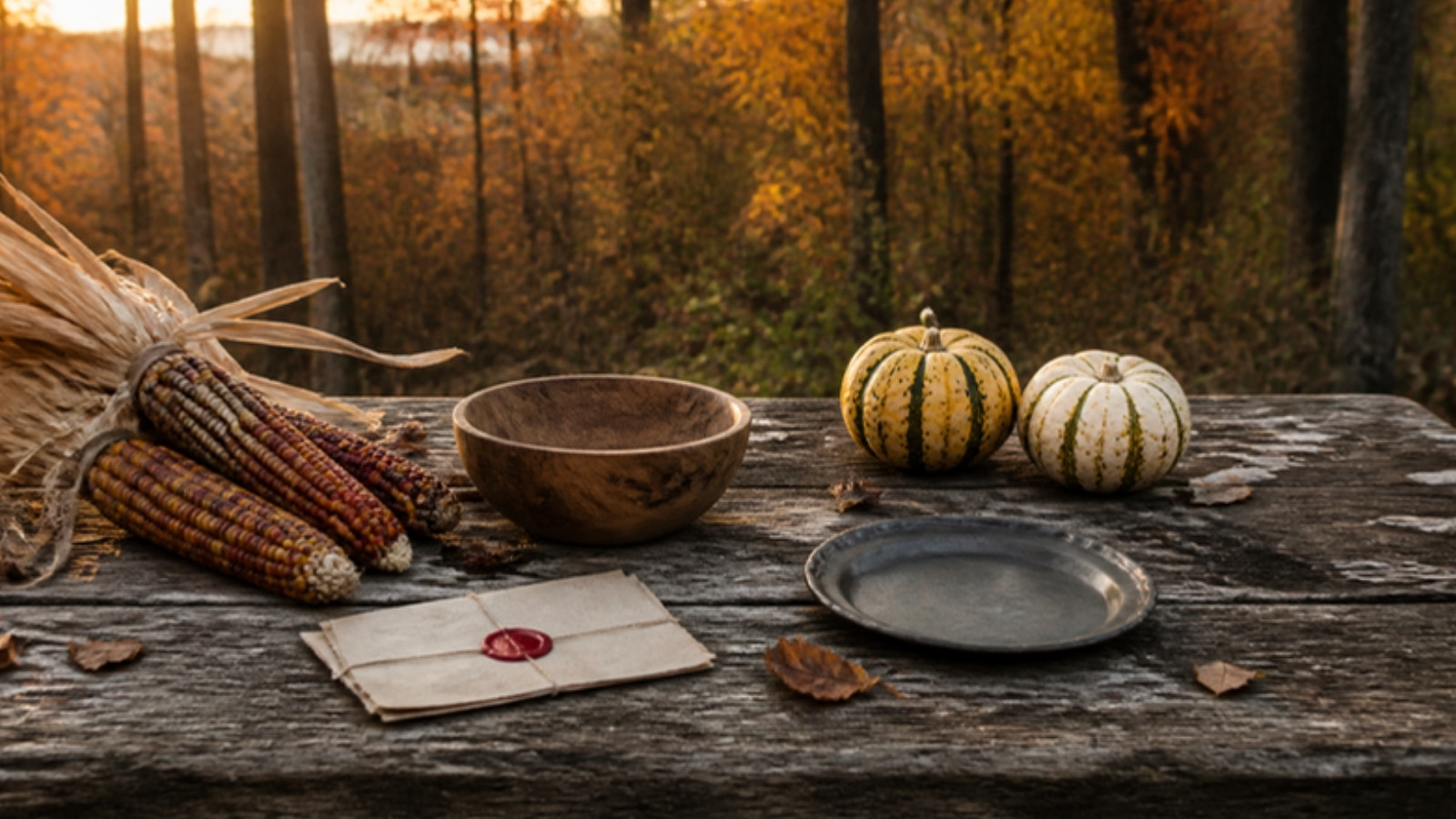
In December 1621, a man named Edward Winslow sat down in the tiny settlement at Plymouth and wrote a letter to a friend back in England. He’d come over on the Mayflower the year before, and by the time he wrote that letter, about half of the 102 people on that ship were dead.
In spite of that tragic turn of events, Winslow had some good news to share. The harvest had come in, so the governor sent four men out to hunt birds, and in one day they brought back enough (with a little help) to feed the whole colony for almost a week.
Then Massasoit, the leader of the Wampanoag, the local native Indian tribe, showed up with about 90 of his men. Winslow wrote that the colonists “entertained and feasted” them for three days, and the Wampanoag went out, killed five deer, and gave them to the governor and some of the other leaders.
That’s the feast you and I learned about in school as the first Thanksgiving.
Winslow closed that part of his letter with a line that really shows the deep gratitude and thankfulness he had in his heart: “And although it be not always so plentiful as it was at this time with us, yet by the goodness of God, we are so far from want that we often wish you partakers of our plenty.” In plain English, he’s saying we don’t always have this much, but God has been so good to us that we wish you were here to share it.
That letter is the only eyewitness account of the so-called first Thanksgiving feast that survives, and the word “thanksgiving” isn’t anywhere in it.
##### Nobody called it Thanksgiving until 1841
Even though I used to be a middle school American history teacher, I must admit I didn’t know this until I started digging into this week’s article. I always assumed the Pilgrims sat down at that table and called it Thanksgiving. They didn’t.
Now, let me be clear: that is not to say that they weren't giving thanks. It is not to say that they weren't grateful. It is not to say that they weren't thanking God for His provisions. It is not to say that they weren't thankful to the local Indians for helping provide the plenty that they were experiencing. They simply didn’t call it “Thanksgiving Day.”
To these colonists, a day of thanksgiving was a holy day. When God did something big for them, their leaders would set apart a day for church services and prayer, and often fasting.
Let me give you an example of a real Pilgrim thanksgiving. In the summer of 1623, a drought threatened their whole harvest, so the governor called a day of humiliation and prayer to ask God’s forgiveness. Winslow wrote that “the clouds gathered together on all sides,” and the next morning they got “soft, sweet, and moderate showers of rain.” After the drought ended, they set apart another day just to thank God for the rain.
So if the Pilgrims were in the habit of setting aside special days to give thanks when good things happened, how did the 1621 feast end up with the name? In 1841, a Boston pastor named Alexander Young published a collection of the Pilgrims’ writings, Winslow’s letter included, and under it he added a footnote: “This was the first Thanksgiving, the harvest festival of New England.” As far as historians can tell, he was the first person to call it that).
It took 220 years for anybody to actually call it Thanksgiving Day. That’s a fun piece of trivia for the table tomorrow, but it doesn’t change what happened that fall. The people at that feast had survived their first year in Plymouth, they had plenty to eat, and Winslow gave God the credit for it. Whatever you want to call it, they were thankful.
##### It took 242 years and a civil war to make it a national holiday
If the Pilgrims didn’t name it, who turned it into a holiday? It took a lot of people a long time.
George Washington declared a national day of thanksgiving on November 26, 1789, but it didn’t become an annual holiday or even a yearly “thing”. Presidents after him proclaimed one only once in a while.
The person who finally made it stick was a woman named Sarah Josepha Hale. She edited Godey’s Lady’s Book, the most widely circulated women’s magazine in America up to that time, and according to the National Park Service, she spent 36 years pushing for a national Thanksgiving. She wrote editorials about it, and she wrote letters to governors and presidents, year after year.
(By the way, she’s also the woman who wrote “Mary Had a Little Lamb,” so now you’ve got two things to say at Thanksgiving dinner tomorrow to impress your weird uncle.)
On September 28, 1863, Hale wrote to Abraham Lincoln. Five days later, Lincoln issued a proclamation setting apart “the last Thursday of November next, as a day of Thanksgiving and Praise,” and America has celebrated Thanksgiving every year since.
That’s interesting in and of itself, but it becomes even more so when you think about when Lincoln did that. It was three months after Gettysburg, in the middle of the deadliest war in American history. His proclamation admits the country is “in the midst of a civil war of unequaled magnitude and severity,” and it asks Americans to pray for “all those who have become widows, orphans, mourners, or sufferers.” Families all over the country were burying their sons, and the president asked them to stop and give thanks anyway.
Even then, Thanksgiving wasn’t a fixed date on the calendar. In 1939, the last Thursday of November fell on the 30th, and Franklin Roosevelt worried that a short Christmas shopping season would hurt the economy, so he moved Thanksgiving up a week. Thirty-two states went along with him, 16 refused, and for two years America had two different Thanksgivings. (People called Roosevelt’s version “Franksgiving.” Can you imagine arguing with your in-laws over which Thursday was the real one?)
Congress finally settled it by fixing Thanksgiving to the fourth Thursday of November, and Roosevelt signed it on December 26, 1941, less than three weeks after Pearl Harbor.
##### You don’t have to wait for a good year to be thankful
Lincoln asked a country at war to give thanks, and I think this is where a lot of us get Thanksgiving wrong. Unfortunately, we treat gratitude like something that shows up after life settles down, and we tell ourselves we’ll be thankful once the business turns around or once the doctor says everything’s fine.
That’s the golden cage in this one. Waiting seems reasonable. After all, why would you thank God for a year that knocked you flat? But the truth is there’s always something that isn’t fixed yet, so you can end up waiting your whole life for permission to be grateful.
Now look at the people this holiday came from. The Pilgrims feasted with the Wampanoag less than a year after burying about half of their own people, and Winslow still wrote “by the goodness of God.”
They also had help that year, and a lot of it came from a man named Squanto. In 1614, an English captain named Thomas Hunt kidnapped him and about two dozen other Native people and took them to Spain to sell as slaves. Squanto somehow made his way to London, and along the way he learned to speak English, which, as it turns out, would be very helpful for the Pilgrims in the future. When he finally got home in 1619, he found most of his people dead from disease.
When the Pilgrims showed up the next year, the last thing they expected to hear was English. In March 1621, a Native man named Samoset walked into Plymouth and spoke to them in broken English, and William Bradford, Plymouth’s longtime governor, wrote that they “marveled at it.” Samoset told them about another man, Squanto, who “could speak better English than himself.” Squanto became their interpreter, and he showed them how to plant corn and where to catch fish. Bradford later called him “a special instrument sent of God for their good beyond their expectation.”
So what happens when you stop waiting and start being thankful now? In 2003, two psychologists, Robert Emmons and Michael McCullough, tested this idea. They asked people to keep a short list every week. One group wrote down things they were grateful for, and the other groups wrote down hassles or ordinary events. The people who kept the gratitude list exercised more regularly, reported fewer physical symptoms, felt better about their lives as a whole, and were more optimistic about the coming week.
##### Solomon said the cheerful heart has a feast that never ends
Solomon has a proverb that fits this week:
“All the days of the afflicted are evil, but the cheerful of heart has a continual feast.” (Proverb 15:15, ESV)
The way I read it, Solomon is comparing two people who could be living through the same hard days. To the afflicted man, every one of those days is bad. The cheerful man has a “continual feast,” a feast that doesn’t stop. The difference between those two men is in their hearts. It’s in how they show gratitude and how they practice it.
The Pilgrims sat down to this kind of feast in 1621, the same year they’d buried half their people, and in 1863 Lincoln asked the whole country to thank God for all of our blessings in the middle of a war.
Maybe this year was a hard one for you, and you lost somebody or you’re carrying something nobody at that table tomorrow knows about. You don’t have to wait for a better year to be thankful for what God did give you in this one.
So before anybody touches the turkey, thank God, out loud, for the people He sent to help you this year, and say their names.
Before You Go
Get What’s Real? free every Wednesday. One lie dismantled, one truth delivered, with the research behind it. Subscribe at therealjasonduncan.com/articles.
Prefer to listen? Every article becomes a Wednesday episode of The Real Jason Duncan Podcast, and every Monday I interview an entrepreneur who lived one of these lies. Find it at therealjasonduncanpodcast.com.
– The Real Jason Duncan
– The Real Jason Duncan